
In the Footsteps of St. Louis Marie de Montfort


"Footsteps Online"
Christmas 1998 (Volume 4, Issue 1)
St. Louis Marie's Birthplace
A group of Montfortians (Montfort Missionaries, Daughters of Wisdom and Brothers of St. Gabriel) are at present taking part in a course in Rome entitled "Living and Promoting Montfortian Spirituality" - they are mostly destined to be involved in some way in the training of future members of the three Montfortian Congregations. During the month of February they will be making a pilgrimage "In the Footsteps of St. Louis Marie" to the various places associated with his life and work. Among these places will be, of course, the town where he was born and (more importantly) baptised…
 MONTFORT-SUR-MEU
is a small town a few kilometres to the West of Rennes in Brittany.
It stands at the junction of the Rivers Meu and Garun, and has
an ancient history, which even involves an English nobleman who
disagreed with William the Conqueror. It used to be known as "Montfort-la-Cane",
recalling an ancient legend of a fair young princess and a duck.
At the time of St. Louis Marie de Montfort's birth, it may have
been more thriving than it is today, since it had three parishes,
where today there is only one. One of these parishes, that of
Saint-Jean (St. John), included that quarter of the town just
inside the walls which overlooked the bank of the River Meu. And
in the Rue de la Saulnerie in this quarter was the house (no.
15) in which St. Louis Marie was born on 31 January 1673.
MONTFORT-SUR-MEU
is a small town a few kilometres to the West of Rennes in Brittany.
It stands at the junction of the Rivers Meu and Garun, and has
an ancient history, which even involves an English nobleman who
disagreed with William the Conqueror. It used to be known as "Montfort-la-Cane",
recalling an ancient legend of a fair young princess and a duck.
At the time of St. Louis Marie de Montfort's birth, it may have
been more thriving than it is today, since it had three parishes,
where today there is only one. One of these parishes, that of
Saint-Jean (St. John), included that quarter of the town just
inside the walls which overlooked the bank of the River Meu. And
in the Rue de la Saulnerie in this quarter was the house (no.
15) in which St. Louis Marie was born on 31 January 1673.
 The house
has been restored to recall its most famous inhabitant, and is
today owned by the three Montfortian Congregations. As a place
of pilgrimage, it receives many visitors, who, through the various
relics and memorial items gathered there, are able to drink in
something of the spirit of the Saint. There is, for example, the
statue of Our Lady of Wisdom in the little oratory, which is said
to have been venerated by St. Louis Marie in his hermitage at
Saint-Lazare, not far from the town, and which may even have been
carved by him. There is the outdoor oratory in the garden, recalling
the way in which he adorned the chapel at Saint-Lazare. And there
is the beautiful ceramic by Montfort Missionary Fr. Leidi, commemorating
the baptism of St. Louis Marie the day after his birth in the
church of Saint-Jean.
The house
has been restored to recall its most famous inhabitant, and is
today owned by the three Montfortian Congregations. As a place
of pilgrimage, it receives many visitors, who, through the various
relics and memorial items gathered there, are able to drink in
something of the spirit of the Saint. There is, for example, the
statue of Our Lady of Wisdom in the little oratory, which is said
to have been venerated by St. Louis Marie in his hermitage at
Saint-Lazare, not far from the town, and which may even have been
carved by him. There is the outdoor oratory in the garden, recalling
the way in which he adorned the chapel at Saint-Lazare. And there
is the beautiful ceramic by Montfort Missionary Fr. Leidi, commemorating
the baptism of St. Louis Marie the day after his birth in the
church of Saint-Jean.
This ceramic
recalls the real significance of Montfort-sur-Meu for St.
Louis Marie himself. For, though he was born in the town, he lived
there for only a very short time, perhaps even only a matter of
weeks.  He was given into the care of a wet-nurse, Mother André,
almost immediately after his birth, and went to live with her
in the nearby hamlet of La Bachelleraie. Shortly after his return
home about two years later, the family moved to the farmhouse
known as "Le Bois Marquer" close to the neighbouring
town of Iffendic.
He was given into the care of a wet-nurse, Mother André,
almost immediately after his birth, and went to live with her
in the nearby hamlet of La Bachelleraie. Shortly after his return
home about two years later, the family moved to the farmhouse
known as "Le Bois Marquer" close to the neighbouring
town of Iffendic.
The reason why St. Louis Marie preferred in his later life to be known simply as "the priest from Montfort" ("Le Père de Montfort"), was not because he was born in Montfort, but because he was baptised there. For him Baptism was the most important event in his life, because it was in his Baptism that he became a child of God. And this was the beginning of the great adventure which was his whole life - his call to help to build the Kingdom of God in our all-too-human world.
The aim of St. Louis Marie in all the missions he preached in his later life, was to bring his hearers to a deeper realisation of the reality of their Baptism, and to get them to renew their Baptismal commitment to Jesus Christ. He saw it as extremely important that every Christian should personally ratify this Baptismal commitment when they became old enough to do so. And so, in Fr. Leidi's ceramic, we see the adolescent Louis Marie, in the bottom left-hand corner, signing his own renewal of Baptismal vows, as he encouraged all his hearers to do later on.
 Montfort-sur-Meu contains
another precious relic of the Baptism of St. Louis Marie. It is
the record, in the old parish register, of this event, which is
kept today at the Town Hall (Mairie). Even though the writing
has faded somewhat, certain details are still quite clearly seen
even in a photograph, such as the signature of Louis Marie's uncle,
Felix Grignion, and that of the priest who baptised him, Fr. Pierre
Hindré. The town is very proud of one of its most famous
sons, and preserves this relic with care. It is not always on
show, but you can make an appointment to see it.
Montfort-sur-Meu contains
another precious relic of the Baptism of St. Louis Marie. It is
the record, in the old parish register, of this event, which is
kept today at the Town Hall (Mairie). Even though the writing
has faded somewhat, certain details are still quite clearly seen
even in a photograph, such as the signature of Louis Marie's uncle,
Felix Grignion, and that of the priest who baptised him, Fr. Pierre
Hindré. The town is very proud of one of its most famous
sons, and preserves this relic with care. It is not always on
show, but you can make an appointment to see it.
Just opposite the Town Hall is all that remains of the old church of Saint-Jean, where St. Louis Marie was baptised. The church itself was demolished many years ago, but the small chapel of St. Joseph was built from some of its stones, and it is said the door of the chapel is that of the old church. Behind it, in the grounds of the present presbytery, are the remains of the old sacristy of the parish church, today used as a kind of parish centre.
 The actual parish church is dedicated to St. Louis Marie de Montfort,
and stands on the site of one of the early disappointments suffered
by him in his life as a preacher of parish missions. In September
1707, he came back to his home town in the company of M. Leuduger
and his team of missionaries to take part in the giving of a parish
mission for the whole town. He remembered a prominent hillock
close to the town walls known as the Butte de la Motte,
and decided it would be an ideal place to erect a Calvary to remind
the people of the mystery of their salvation. He even had statues
made to adorn the Calvary. His superiors, however, had other ideas,
and he was forbidden to build the Calvary. He contented himself
with prophesying that, in the future, that very spot would be
a place of prayer… and so it turned out, when the present
parish church was built there in 1850 to replace the three which
had existed before.
The actual parish church is dedicated to St. Louis Marie de Montfort,
and stands on the site of one of the early disappointments suffered
by him in his life as a preacher of parish missions. In September
1707, he came back to his home town in the company of M. Leuduger
and his team of missionaries to take part in the giving of a parish
mission for the whole town. He remembered a prominent hillock
close to the town walls known as the Butte de la Motte,
and decided it would be an ideal place to erect a Calvary to remind
the people of the mystery of their salvation. He even had statues
made to adorn the Calvary. His superiors, however, had other ideas,
and he was forbidden to build the Calvary. He contented himself
with prophesying that, in the future, that very spot would be
a place of prayer… and so it turned out, when the present
parish church was built there in 1850 to replace the three which
had existed before.
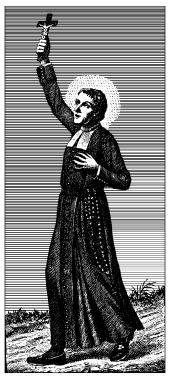
It was during this mission in Montfort that there took place what has sometimes been referred to as "the sermon of the crucifix". Instead of preaching, St. Louis Marie simply held up his crucifix, and said with great feeling, "See what our sins have done to our Saviour!" He then got all the people to come and kiss the crucifix, and it is said that they were more moved than if he had spoken the most eloquent words possible. This incident is commemorated by the statue in the tower of the present parish church, in which we see the saint holding up his crucifix.
The Catholic people of Montfort-sur-Meu still treasure the memory of their own saint, even if he didn't live among them for very long!
